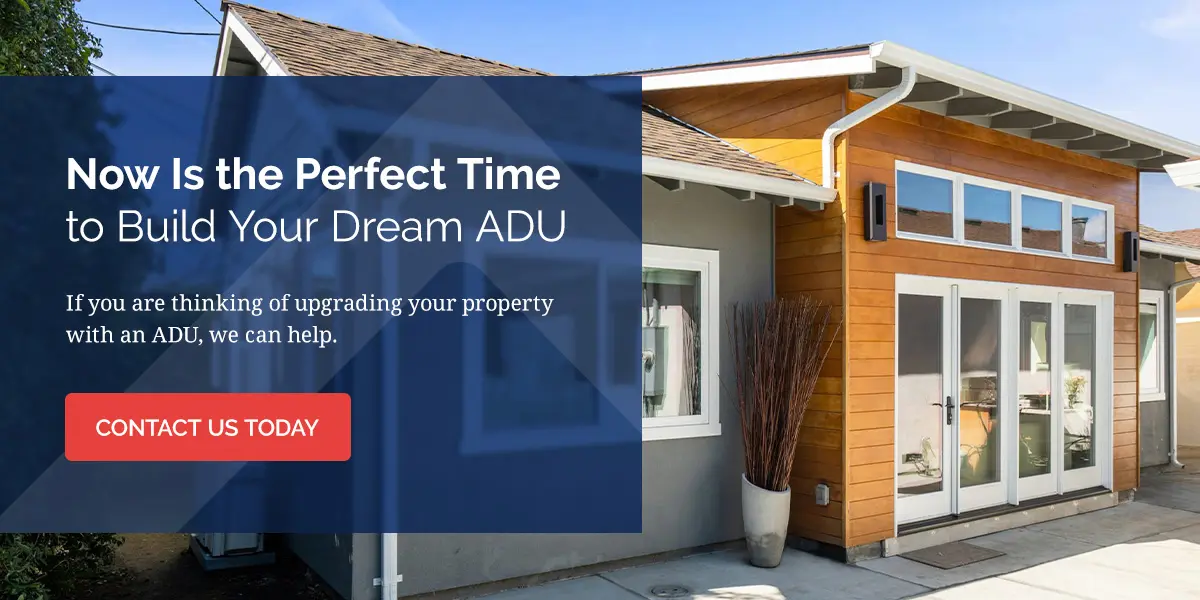
An accessory dwelling unit (ADU) is a secondary residence that can be built on a property. These structures, also known as accessory suites and in-law suites, are often used to house aging parents or in-laws.
Depending on your needs and property goals, you can choose from several types of ADUs, ranging from an interior conversion to a detached unit. No matter what kind of secondary residence you build, you will need to follow several ADU laws and regulations to ensure you remain in compliance.
Importance of ADU Laws
While they were not always allowed, ADUs can now be built throughout the state, offering you the opportunity to expand your property and create a private space for residents.
While ADU laws in California are often thought of as having harsh restrictions, they serve an important purpose. ADU ordinances are designed to guide the construction process and ensure builders and homeowners follow size limitations and zoning laws.
ADUs are now allowed throughout the state, but it is vital to consider more local ordinances as well since the laws can vary by location. It is necessary to familiarize yourself with the state and local housing laws since noncompliance with ADU regulations in California can lead to consequences ranging from fines to legal issues.
Key ADU Laws and Regulations
Over time, ADU ordinances and laws can change, which is another reason it is so important to review them carefully prior to construction. Here are a few of the latest changes and what you need to know about them:
Lot sizes: No matter your lot size, you can now build an ADU that is at least 850 square feet and one junior accessory dwelling unit (JADU) that is less than 500 square feet on your property. The size, lot and setback requirements are not as stringent. Also, if you have a structure like a garage that you would like to convert into additional living space, you can turn it into an ADU.
Owner occupancy: There are no owner occupancy restrictions to follow before you build. You do not need to live in either the ADU or primary residence, so you can build on a more diverse range of properties.
Permitting: Previously, most permits would take around 120 days to obtain. Now, you can expect single- and multifamily units to either be approved or denied within 60 days, making the process much easier and more efficient. One way to streamline your ADU project is by selecting from our pre-approved ADU options already vetted by local jurisdictions.
Lower fees: If your ADU is less than 750 square feet, you will not have to deal with fees from water companies, local agencies or special districts. Keep in mind that if your ADU is above this square footage, you will be required to pay some fees based on the square footage of the unit itself and the primary residence.
Financial aid: Because ADUs are smaller and more affordable residences, they have been incentivized to encourage building more of these structures. Several financial incentives and state grants are available to help encourage homeowners to choose ADU construction for their living spaces.
Homeowners association (HOA) rules and restrictions: If there were any homeowners association restrictions dictating whether you could build an ADU on specific properties, those have now been overruled. Even if the association says otherwise, you can still build an ADU on your property. This permission applies to all areas subject to HOA rules, including historic districts.
Parking requirements: There are several ways to avoid being subjected to ADU parking standards, ranging from being located in a historic district to building the ADU within one-half mile of public transit. Also, if you transform an area like a carport or garage into an ADU, you will not need to add a replacement parking space.
Benefits of Complying With ADU Laws
Noncompliance with California ADU regulations can have significant consequences. Depending on the rules and regulations you fail to comply with, you could face fines or even encounter legal issues. Understanding and complying with ADU laws can make the process run more smoothly and efficiently. When you align your build with local regulations, you can encourage communication and safety for the construction crew and residents.
By complying with the laws, you will have the opportunity to create accessible housing for families with aging relatives or budget constraints — while enhancing the property value.
Common Challenges With ADU Requirements and Laws
You may face a few challenges when dealing with or trying to remain in compliance with some of the ADU requirements and laws. The zoning regulations can be complex to navigate. While you can build an ADU in a residential area, there will be other regulations to keep in mind if you plan on constructing one in areas like mixed-use districts.
It is also important to understand and follow the permit processes and requirements. There have been several state and local laws that have prevented homeowners from being able to design and build an ADU on their property. While many of these have been lifted, there are still laws to ensure responsible development.
Even when working under total compliance, you may have to address various community concerns and respond to these questions or views in an informed and effective manner.
Interested in Learning More About Accessory Dwelling Unit Laws in California?
Being aware of the ADU laws in your area can make the design and development process run much more smoothly, helping you finish your structure faster and in complete compliance. From knowing about the different restrictions to zoning requirements, working with a full-service home remodeling and expansion company can ensure the process is a success.
At Valley Home Builders, we encourage you to seek legal guidance to ensure you remain in compliance and the entire process goes smoothly. We employ a team of experts who specialize in home remodeling and expansion projects and who are here to help guide you every step of the way.
If you are interested in learning more and exploring more resources, we encourage you to reach out today to receive a free consultation.


 ADUs
ADUs